
Behind the Outbreak's Headlines
Legionella outbreaks rarely come as a complete surprise.
In most cases, they are the result of gaps that existed long before the first case was identified, gaps in system oversight, monitoring, or response. When outbreaks make headlines, the immediate focus is often on the number of cases or the source. But the more important question is what led to that point, and what could have been done differently.
The Recent Reminder: The Nevada Outbreak
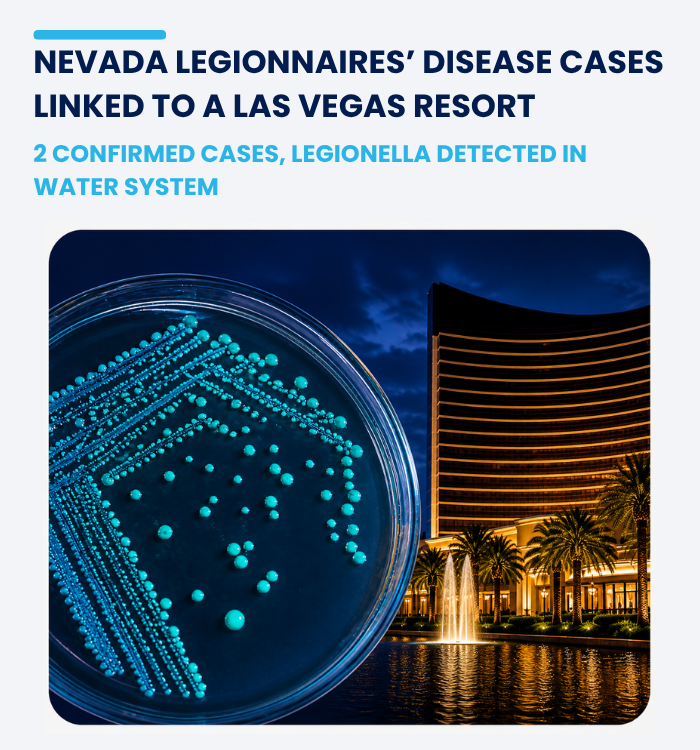
The Southern Nevada Health District has recently confirmed two cases of Legionnaires' disease linked to a major Las Vegas resort, with Legionella detected in the facility's water system, highlighting once again how quickly water system risks can become public health concerns.
While investigations are ongoing, the situation reflects a pattern seen in past outbreaks, issues within building water systems that were not fully identified or addressed before exposure occurred.
Cases like this don't just draw attention because of the number of infections. They highlight something more important: How easily risk can remain hidden until it becomes visible.
And once it does, the response is no longer internal, it becomes public, regulatory, and urgent.
What Outbreaks Have Shown
In recent years, states like New York and New Jersey have faced repeated Legionella outbreaks, many of them tied to building water systems like cooling towers.
In one of the most significant cases, a 2015 outbreak in the Bronx led to over 100 infections and multiple deaths, ultimately traced back to a contaminated cooling tower.
More recently, outbreaks in New York City have again been linked to cooling oversight.
These events didn't just impact public health. They triggered regulatory action, operational changes, and increased scrutiny across facilities.
How Regulations Changed After Outbreaks
One of the most immediate outcomes of major outbreaks is regulatory change.
- New York implemented strict cooling tower registration, testing, and maintenance requirements following major outbreaks.
- New Jersey introduced legislation requiring water management programs across building types, aligning with ASHRAE 188.
What started as reactive measures quickly became baseline expectations for Legionella compliance. And those expectations are still expanding.
What Actually Causes Outbreaks
Despite differences in location or facility type, the underlying causes of Legionella outbreaks are often similar. Systems may not be consistently maintained, monitoring may be irregular, or response actions may be delayed when early warning signs appear. In some cases, a program exists on paper but is not actively followed in practice.
Legionella bacteria thrive in conditions that are common in building water systems; warm temperatures, stagnation, and complex plumbing networks. Without consistent oversight, these environments can quickly become high-risk.
The Real Lessons for Facilities
1. Waiting for a Problem Is the Most Expensive Strategy
Many outbreaks occur in environments where:
- No routine monitoring or testing was in place
- Programs existed but weren't actively followed
By the time an outbreak is detected, the cost is no longer just operational, it becomes public, legal, and reputational.
2. Compliance Alone Isn't Enough
Some affected facilities were technically "compliant."
But compliance doesn't always mean:
- Systems are under control
- Risks are actively managed
- Issues are caught early
The gap between compliance and control is where outbreaks happen.
3. Water Management Programs Must Be Active, Not Static
A written plan is not protection.
Effective programs require:
- Regular validation
- Updated sampling strategies
- Clear corrective actions
4. Testing Must Support Decisions
Testing is only valuable if:
- Results are reliable
- Data is interpreted correctly
- Actions follow quickly
Delayed or unclear results can turn a manageable issue into a crisis.
Beyond Compliance: Safeguarding Occupants and Your Brand
At the center of every outbreak are people, patients, residents, staff, and visitors. In high-risk environments, the consequences are not theoretical. They can affect health outcomes, extend hospital stays, and in severe cases, result in loss of life.
But the impact does not stop there. Once an outbreak becomes public, it brings increased scrutiny, potential legal exposure, and long-term reputational damage. For many organizations, the question that follows is not just what happened, but whether it could have been prevented.
Facilities working with experienced partners like I-2-I Solutions often focus on closing these gaps before they lead to larger issues.
The Cost of an Outbreak Goes Far Beyond Remediation
When a Legionella outbreak occurs, the impact is not limited to identifying the source and resolving the issue. The financial and operational consequences can escalate quickly, often extending far beyond the initial response.
Direct costs typically include emergency sampling, system disinfection, follow-up testing, and, in some cases, temporary shutdowns or restrictions on water use. These actions are necessary to regain control, but they can be disruptive and resource-intensive, especially in complex facilities.
Beyond that, there are indirect costs that are often more difficult to quantify. Facilities may face regulatory investigations, legal exposure, and increased scrutiny from oversight bodies. In healthcare environments, this can also affect survey readiness and compliance standing.
Reputational impact is another critical factor. Once an outbreak becomes public, it can influence how a facility is perceived by patients, residents, and the broader community. Rebuilding trust can take time and, in some cases, require significant operational and communication efforts.
All together, these costs highlight an important reality: responding to an outbreak is almost always more expensive, financially and operationally, than maintaining a proactive, well-managed program.
In many cases, the question is not whether a facility can respond to an outbreak, but whether it could have prevented the conditions that led to it.
From Insight to Action: How I-2-I Solutions Supports Real Control
Understanding why outbreaks happen is only part of the equation.
The real challenge for facilities is turning that understanding into consistent, defensible action.
At I-2-I Solutions, we work with healthcare and high-risk facilities to close the exact gaps that often lead to outbreaks, gaps in visibility, validation, and response.
Our approach is built around what outbreaks repeatedly reveal:
- where monitoring is missing or inconsistent
- where programs exist but aren't actively followed
- and where testing data isn't being used to drive timely decisions
Through a combination of in-house Legionella testing, ISO/IEC 17025-accredited laboratory practices, and support aligned with real-world water management program execution, we help facilities move beyond compliance toward actual control.
This includes:
- designing sampling strategies that reflect system risk
- delivering reliable, decision-ready results
- and supporting teams in interpreting findings and responding effectively
Because in practice, preventing an outbreak isn't about doing more.
It's about knowing where your system stands, and acting before risk escalates.